
Defining FinOps in 2026
FinOps (Financial Operations) is the operating model for the cloud. It brings financial accountability to the variable spend model of cloud, enabling distributed teams to make business trade-offs between speed, cost, and quality.
In 2026, FinOps has moved beyond "cost cutting" to "value realisation". It asks:"Are we getting $10 of value for every $1 we spend on AWS?"
Phase 1: Inform
Visibility
- Implement a consistent tagging strategy across all cloud resources
- Establish showback reporting so teams see what they spend
- Move to chargeback as FinOps maturity grows
Phase 2: Optimise
Reduction
- Purchase Savings Plans or Reserved Instances for steady-state workloads (up to 72% savings)
- Shift fault-tolerant workloads to Spot Instances (up to 90% savings)
- Right-size over-provisioned resources based on actual utilisation data
- Migrate compute to Graviton ARM processors for 20% better price-performance
Phase 3: Operate
Culture
- Embed unit economics tracking - measure cost per customer or cost per transaction
- Make engineers financially accountable for the services they own
- Automate infrastructure sizing with tools like Karpenter and Cast.ai
- Review cloud spend in engineering stand-ups alongside performance and reliability
Phase 1: Inform (Visibility)
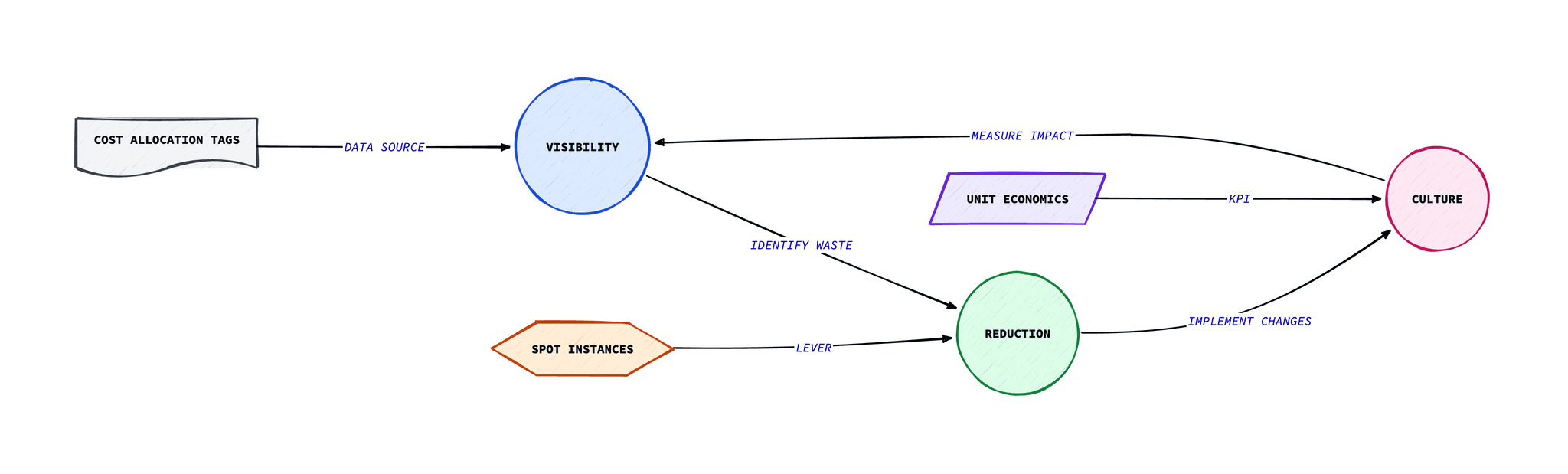
The first step is seeing where the money goes.
Tagging Strategy
A consistent tagging policy is non-negotiable. Every resource must have:
CostCentre: Who pays for this?Environment: Prod, Staging, or Dev?Service: Which microservice does this belong to?Owner: Who can shut this down?
Showback vs. Chargeback
Showback: Showing teams what they spent. Good for early maturity.
Chargeback:Deducting the cost from the team's actual budget. Essential for mature organisations.
Phase 2: Optimise (Reduction)
Once you see the waste, eliminate it.
Rate Optimisation
Paying less for what you use.
- Savings Plans / RIs: Commit to 1-3 years for steady-state workloads (up to 72% savings).
- Spot Instances: Use for fault-tolerant workloads (batch processing, CI/CD runners) for up to 90% savings.
Usage Optimisation
Using less.
- Right-sizing: Moving from
c5.2xlargetoc5.largebased on actual CPU metrics. - Storage Lifecycle: Moving old S3 data to Glacier Deep Archive automatically.
- Graviton (ARM): Migrating to ARM-based processors for 20% better price-performance.
Taming Kubernetes Costs
Kubernetes is a "black hole" for costs because multiple teams share the same cluster. Attribution is hard.
Requests vs. Limits
Developers often over-provision "just to be safe". This leads to slack capacity; you pay for nodes that are 10% utilised.
Solution: Use Goldilocks or Kubecost to identify optimised resource requests based on historical usage.
Bin Packing
Use Karpenter for node autoscaling. Unlike the standard Cluster Autoscaler, Karpenter looks at the pending pods and provisions the exact right instance type to fit them, eliminating waste.
Architectural Cost Optimisation
The biggest savings come from architecture changes, not just rate negotiation.
- Serverless: Lambda scales to zero. No paying for idle time.
- CDN Caching: Offload traffic from expensive origin servers to cheap CloudFront edges.
- Database Choice: DynamoDB (On-Demand) eliminates the need to provision for peak capacity.
The FinOps Toolchain
| Category | Tools |
|---|---|
| Native Cost Management | AWS Cost Explorer, Azure Cost Management |
| Kubernetes Costing | Kubecost, Cast.ai, OpenCost |
| SaaS Platforms | CloudZero, Vantage, Datadog Cloud Cost |
| Automation | Karpenter, Spot.io |
Conclusion
FinOps is the ultimate alignment tool. It aligns engineering with finance, and technology with business goals. By shifting cost accountability left, engineers gain the context to build efficiently.