
The Rise of Agentic AI
2026 marks a fundamental shift in how enterprises deploy AI. We've moved beyond chatbots and co-pilots to autonomous agents that can independently execute complex, multi-step workflows. According to Gartner, by the end of 2026, 40% of enterprise AI deployments will involve agentic systems, up from less than 5% in 2024.
This shift is driven by three converging factors: foundation models with improved reasoning capabilities (GPT-4.5, Claude 4, Gemini 2.0), mature orchestration frameworks that handle complex agent workflows, and enterprises discovering that the real ROI from AI comes from automation, not just augmentation.
But agentic AI also introduces new challenges. Autonomous systems require different governance models, safety mechanisms, and operational practices than traditional AI. This guide provides a complete blueprint for enterprises looking to deploy agentic AI responsibly and effectively.
The Autonomy Spectrum
Agentic AI exists on a spectrum from "co-pilot" (human drives, AI assists) to "autopilot" (AI drives, human monitors). Most enterprise deployments in 2026 sit somewhere in the middle: agents with bounded autonomy and human checkpoints for critical decisions.
What Makes AI 'Agentic'?
An AI system becomes "agentic" when it exhibits these core capabilities:
1. Goal-Directed Behaviour
Agentic AI systems work towards objectives rather than simply responding to prompts. They can decompose high-level goals into actionable sub-tasks, track progress, and adapt their approach based on intermediate results.
2. Planning and Reasoning
Agents engage in multi-step reasoning to determine the best course of action. This includes chain-of-thought reasoning, task decomposition, and the ability to revise plans when encountering obstacles.
3. Tool Use and Action
Unlike passive AI that only generates text, agentic AI can take actions in the real world through tool use: executing code, calling APIs, querying databases, sending emails, or interacting with external systems.
4. Memory and Learning
Agents maintain state across interactions, remembering past actions, user preferences, and domain knowledge. Advanced systems can learn from experience to improve future performance.
5. Autonomy with Oversight
The defining characteristic: agents can operate independently but within defined boundaries. They know when to proceed autonomously and when to escalate to humans.
| Capability | Traditional AI | Agentic AI |
|---|---|---|
| Interaction | Single prompt → response | Goal → multi-step execution |
| Context | Stateless or session-bound | Persistent memory across tasks |
| Actions | Generate text/code | Execute tools, APIs, workflows |
| Adaptability | Fixed behaviour | Adjusts based on feedback |
| Oversight | Human-in-the-loop always | Bounded autonomy with escalation |
Agent Architecture Patterns
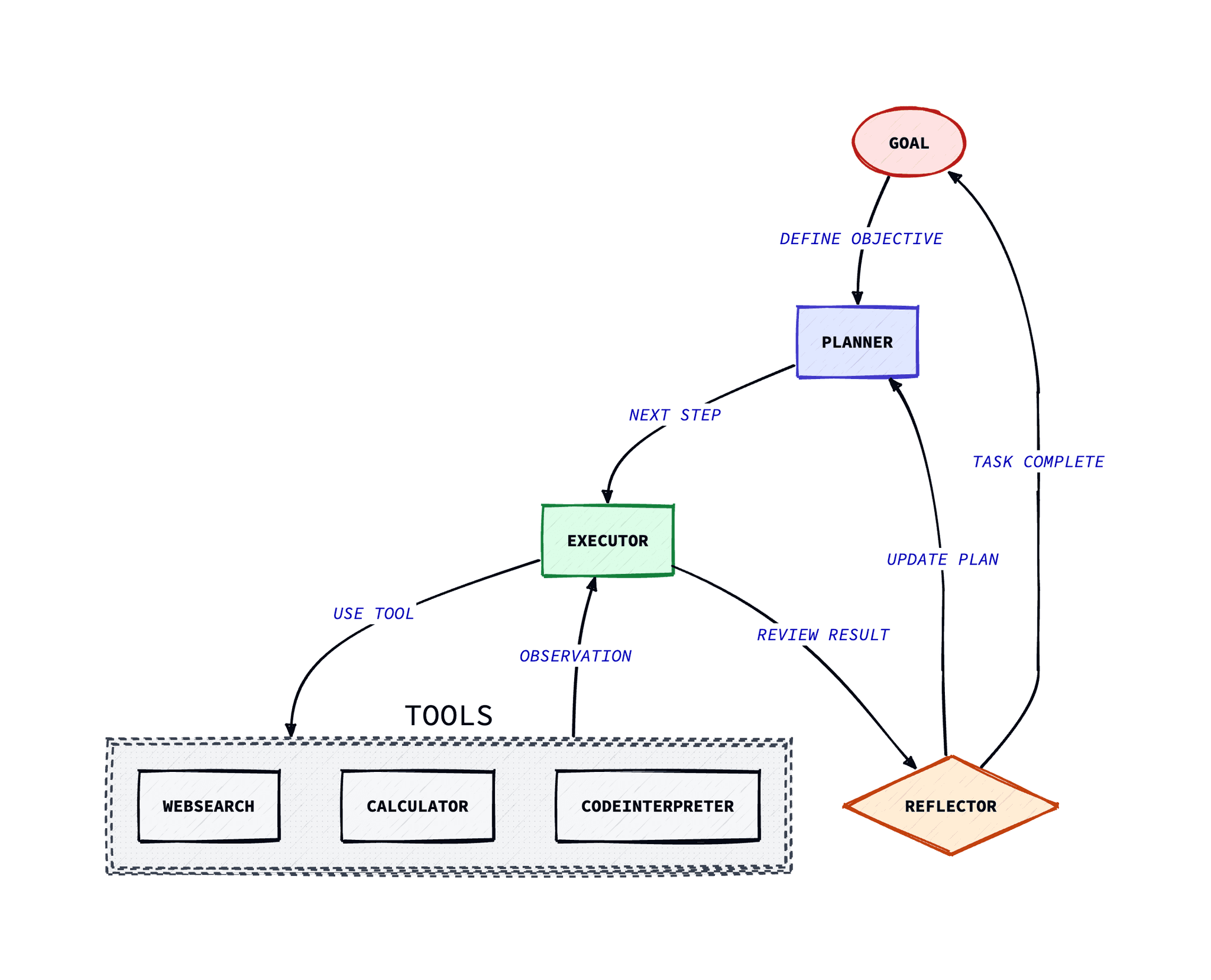
ReAct Pattern (Reasoning + Acting)
The foundational pattern for agentic AI. The agent alternates between reasoning about the current state and taking actions. Each cycle produces observations that inform the next reasoning step.
# ReAct Loop
while not task_complete:
    thought = llm.reason(observation, goal, history)
    action = llm.select_action(thought, available_tools)
    observation = execute_tool(action)
    history.append((thought, action, observation))

    if should_escalate(observation):
        await human_approval()
Plan-and-Execute Pattern
Separates planning from execution. A planning agent creates a detailed task plan, and an execution agent follows it. Better for complex, multi-step tasks where upfront planning improves efficiency.
# Plan-and-Execute
plan = planner_agent.create_plan(goal, context)

for step in plan.steps:
    result = executor_agent.execute(step)

    if result.requires_replanning:
        plan = planner_agent.revise_plan(plan, result)

    plan.mark_complete(step, result)
Multi-Agent Collaboration
Multiple specialised agents work together, each handling a specific domain or capability. An orchestrator agent coordinates their interactions and synthesises results.
# Multi-Agent Orchestration
agents = {
    "researcher": ResearchAgent(),
    "analyst": AnalysisAgent(),
    "writer": WritingAgent(),
    "reviewer": QualityAgent(),
}

async def orchestrate(task):
    research = await agents["researcher"].gather_info(task)
    analysis = await agents["analyst"].analyse(research)
    draft = await agents["writer"].compose(analysis)
    final = await agents["reviewer"].review_and_refine(draft)
    return final
Hierarchical Agents
Manager agents delegate to worker agents, creating a hierarchy. Useful for enterprise scenarios where different levels of authorisation and oversight are required.
Agent Frameworks Comparison
The agentic AI ecosystem has matured significantly. Here's how the leading frameworks compare for enterprise use:
| Framework | Best For | Key Strength | Consideration |
|---|---|---|---|
| LangGraph | Complex, stateful workflows | Graph-based state machines, persistence | Steeper learning curve |
| CrewAI | Multi-agent collaboration | Role-based agents, easy setup | Less control over low-level behaviour |
| AutoGen | Conversational agents | Human-agent chat patterns | Microsoft ecosystem focused |
| Agency Swarm | OpenAI Assistants API | Native OpenAI integration | Vendor lock-in |
| Semantic Kernel | Enterprise .NET/Java | Strong typing, enterprise patterns | Heavier framework |
2026 Recommendation
For most enterprise deployments, we recommend LangGraph for complex workflows requiring fine-grained control, and CrewAI for rapid prototyping of multi-agent systems. Many organisations use both: CrewAI for experimentation, LangGraph for production.
Building with LangGraph
LangGraph provides graph-based orchestration for building reliable, stateful agent workflows. Here's a production-ready example:
Installation and Setup
# Install LangGraph
pip install langgraph langchain-openai langchain-anthropic

# Or with all extras
pip install "langgraph[all]"
Enterprise Agent with LangGraph
from typing import TypedDict, Annotated, Sequence
from langchain_core.messages import BaseMessage, HumanMessage, AIMessage
from langchain_openai import ChatOpenAI
from langchain_core.tools import tool
from langgraph.graph import StateGraph, END
from langgraph.prebuilt import ToolNode
from langgraph.checkpoint.postgres import PostgresSaver
import operator

# Define state schema
class AgentState(TypedDict):
    messages: Annotated[Sequence[BaseMessage], operator.add]
    task_status: str
    requires_approval: bool
    audit_log: list

# Define tools with enterprise guardrails
@tool
def query_database(query: str, database: str) -> str:
    """Execute read-only SQL query against approved databases."""
    approved_dbs = ["analytics", "reporting", "public_data"]
    if database not in approved_dbs:
        return f"Error: Database '{database}' not in approved list"
    # Execute query with read-only connection
    return execute_readonly_query(query, database)

@tool
def send_notification(recipient: str, message: str, channel: str) -> str:
    """Send notification via approved channels."""
    if channel not in ["email", "slack", "teams"]:
        return "Error: Unsupported notification channel"
    return send_message(recipient, message, channel)

@tool
def create_ticket(title: str, description: str, priority: str) -> str:
    """Create support ticket in ITSM system."""
    return create_jira_ticket(title, description, priority)

# Configure LLM with function calling
llm = ChatOpenAI(
    model="gpt-4-turbo-preview",
    temperature=0,
).bind_tools([query_database, send_notification, create_ticket])

# Define graph nodes
def should_continue(state: AgentState) -> str:
    """Determine next step based on agent state."""
    last_message = state["messages"][-1]

    if state["requires_approval"]:
        return "await_approval"
    if last_message.tool_calls:
        return "tools"
    return "end"

def call_model(state: AgentState) -> AgentState:
    """Invoke LLM with current state."""
    messages = state["messages"]
    response = llm.invoke(messages)

    # Check if action requires human approval
    requires_approval = check_approval_required(response)

    return {
        "messages": [response],
        "requires_approval": requires_approval,
        "audit_log": [{
            "action": "llm_response",
            "content": response.content,
            "timestamp": datetime.utcnow().isoformat()
        }]
    }

def await_human_approval(state: AgentState) -> AgentState:
    """Pause for human approval of high-impact actions."""
    # In production, this would trigger a notification
    # and wait for approval via webhook or polling
    approval = request_human_approval(state)

    if approval.approved:
        return {
            "requires_approval": False,
            "audit_log": [{
                "action": "human_approval",
                "approved_by": approval.approver,
                "timestamp": datetime.utcnow().isoformat()
            }]
        }
    else:
        return {
            "messages": [AIMessage(content="Action cancelled by human reviewer")],
            "task_status": "cancelled"
        }

# Build the graph
workflow = StateGraph(AgentState)

workflow.add_node("agent", call_model)
workflow.add_node("tools", ToolNode([query_database, send_notification, create_ticket]))
workflow.add_node("await_approval", await_human_approval)

workflow.set_entry_point("agent")

workflow.add_conditional_edges(
    "agent",
    should_continue,
    {
        "tools": "tools",
        "await_approval": "await_approval",
        "end": END
    }
)

workflow.add_edge("tools", "agent")
workflow.add_edge("await_approval", "tools")

# Compile with persistence
checkpointer = PostgresSaver.from_conn_string(
    "postgresql://user:pass@localhost/agents"
)
app = workflow.compile(checkpointer=checkpointer)
Running the Agent
# Execute agent with thread persistence
config = {"configurable": {"thread_id": "enterprise-task-001"}}

result = app.invoke(
    {
        "messages": [HumanMessage(
            content="Analyse Q4 sales data and send a summary to the leadership team"
        )],
        "task_status": "pending",
        "requires_approval": False,
        "audit_log": []
    },
    config
)

# Resume from checkpoint if interrupted
state = app.get_state(config)
print(f"Current status: {state.values['task_status']}")
Multi-Agent with CrewAI
CrewAI excels at orchestrating teams of specialised agents. Here's how to build an enterprise research and analysis crew:
from crewai import Agent, Task, Crew, Process
from crewai_tools import SerperDevTool, ScrapeWebsiteTool
from langchain_openai import ChatOpenAI

# Configure LLM
llm = ChatOpenAI(model="gpt-4-turbo-preview", temperature=0.1)

# Define specialised agents
market_researcher = Agent(
    role="Senior Market Research Analyst",
    goal="Gather comprehensive market intelligence and competitive analysis",
    backstory="""You are an expert market analyst with 15 years of experience
    in technology sector research. You excel at identifying market trends,
    competitive positioning, and growth opportunities.""",
    tools=[SerperDevTool(), ScrapeWebsiteTool()],
    llm=llm,
    verbose=True,
    allow_delegation=True
)

financial_analyst = Agent(
    role="Financial Analysis Expert",
    goal="Analyse financial data and provide investment recommendations",
    backstory="""You are a CFA charterholder with expertise in equity research
    and financial modelling. You provide data-driven financial assessments.""",
    llm=llm,
    verbose=True
)

strategy_advisor = Agent(
    role="Strategic Planning Director",
    goal="Synthesise research into actionable strategic recommendations",
    backstory="""You are a former McKinsey partner who excels at translating
    complex analysis into clear, actionable business strategies.""",
    llm=llm,
    verbose=True
)

# Define tasks
market_research_task = Task(
    description="""Research the AI infrastructure market for 2026:
    1. Identify top 5 competitors in the GPU cloud space
    2. Analyse pricing trends and market positioning
    3. Document emerging technologies and disruption risks
    4. Assess market size and growth projections""",
    expected_output="Comprehensive market research report with data tables",
    agent=market_researcher
)

financial_analysis_task = Task(
    description="""Based on the market research, analyse:
    1. Revenue projections for key players
    2. Margin analysis and cost structures
    3. Investment requirements for market entry
    4. ROI scenarios for different strategies""",
    expected_output="Financial analysis with projections and sensitivity analysis",
    agent=financial_analyst,
    context=[market_research_task]
)

strategy_task = Task(
    description="""Synthesise the research and analysis into:
    1. Executive summary (1 page)
    2. Strategic options with pros/cons
    3. Recommended approach with rationale
    4. Implementation roadmap with milestones""",
    expected_output="Strategic recommendation document ready for board presentation",
    agent=strategy_advisor,
    context=[market_research_task, financial_analysis_task]
)

# Create and run the crew
analysis_crew = Crew(
    agents=[market_researcher, financial_analyst, strategy_advisor],
    tasks=[market_research_task, financial_analysis_task, strategy_task],
    process=Process.sequential,  # Or Process.hierarchical for manager pattern
    verbose=True
)

result = analysis_crew.kickoff()
print(result)
Tool Use and Function Calling
Tools are what give agents real-world capabilities. Enterprise tool design requires careful attention to security, permissions, and error handling.
Tool Design Principles
- Principle of Least Privilege: Tools should have minimum necessary permissions
- Explicit Over Implicit: Required parameters, not assumed defaults
- Fail Safe: Return informative errors, never fail silently
- Auditable: Log all invocations with full context
- Idempotent Where Possible: Safe to retry on failure
Enterprise Tool Template
from langchain_core.tools import tool
from pydantic import BaseModel, Field
from typing import Optional
import structlog

logger = structlog.get_logger()

class DatabaseQueryInput(BaseModel):
    """Input schema for database query tool."""
    query: str = Field(description="SQL query to execute (SELECT only)")
    database: str = Field(description="Target database name")
    timeout_seconds: int = Field(default=30, description="Query timeout")

class DatabaseQueryOutput(BaseModel):
    """Output schema for database query tool."""
    success: bool
    data: Optional[list] = None
    row_count: int = 0
    error: Optional[str] = None
    execution_time_ms: int = 0

@tool(args_schema=DatabaseQueryInput, return_direct=False)
def secure_database_query(
    query: str,
    database: str,
    timeout_seconds: int = 30
) -> DatabaseQueryOutput:
    """
    Execute a read-only SQL query against an approved enterprise database.

    This tool enforces:
    - Read-only queries (SELECT only)
    - Approved database whitelist
    - Query timeout limits
    - Row count limits for safety

    Returns structured output with success status and data.
    """
    # Validate database access
    approved_databases = get_approved_databases_for_agent()
    if database not in approved_databases:
        logger.warning("database_access_denied",
                      database=database,
                      approved=approved_databases)
        return DatabaseQueryOutput(
            success=False,
            error=f"Access denied: '{database}' not in approved list"
        )

    # Validate query is read-only
    if not is_read_only_query(query):
        logger.warning("write_query_blocked", query=query[:100])
        return DatabaseQueryOutput(
            success=False,
            error="Only SELECT queries are permitted"
        )

    # Execute with timeout and row limit
    try:
        start_time = time.time()
        result = execute_with_timeout(
            query=query,
            database=database,
            timeout=timeout_seconds,
            max_rows=10000
        )
        execution_time = int((time.time() - start_time) * 1000)

        logger.info("query_executed",
                   database=database,
                   rows=len(result),
                   time_ms=execution_time)

        return DatabaseQueryOutput(
            success=True,
            data=result,
            row_count=len(result),
            execution_time_ms=execution_time
        )

    except TimeoutError:
        return DatabaseQueryOutput(
            success=False,
            error=f"Query timed out after {timeout_seconds}s"
        )
    except Exception as e:
        logger.error("query_failed", error=str(e))
        return DatabaseQueryOutput(
            success=False,
            error=f"Query failed: {str(e)}"
        )
Memory and Context Management
Effective memory systems are crucial for agents that need to maintain context across interactions and learning from past experiences.
Memory Types
Short-Term Memory
Current conversation context and working state. Typically stored in the message history and state objects.
Long-Term Memory
Persistent knowledge across sessions. User preferences, learned patterns, and domain knowledge stored in vector databases.
Episodic Memory
Records of past tasks and their outcomes. Enables learning from success and failure patterns.
Semantic Memory
Domain knowledge and facts. Often implemented as RAG over enterprise documentation and knowledge bases.
Vector Memory Implementation
from langchain_openai import OpenAIEmbeddings
from langchain_postgres import PGVector
from datetime import datetime

class AgentMemory:
    """Enterprise agent memory system with multiple memory types."""

    def __init__(self, agent_id: str, user_id: str):
        self.agent_id = agent_id
        self.user_id = user_id
        self.embeddings = OpenAIEmbeddings(model="text-embedding-3-small")

        # Long-term memory store
        self.long_term = PGVector(
            collection_name=f"memory_{agent_id}",
            connection=DATABASE_URL,
            embeddings=self.embeddings
        )

        # Episodic memory for task history
        self.episodic = PGVector(
            collection_name=f"episodes_{agent_id}",
            connection=DATABASE_URL,
            embeddings=self.embeddings
        )

    async def remember(self, content: str, memory_type: str, metadata: dict = None):
        """Store new memory with metadata."""
        doc_metadata = {
            "user_id": self.user_id,
            "timestamp": datetime.utcnow().isoformat(),
            "memory_type": memory_type,
            **(metadata or {})
        }

        store = self.long_term if memory_type == "knowledge" else self.episodic
        await store.aadd_texts([content], metadatas=[doc_metadata])

    async def recall(self, query: str, memory_type: str = "all", k: int = 5) -> list:
        """Retrieve relevant memories."""
        filters = {"user_id": self.user_id}
        if memory_type != "all":
            filters["memory_type"] = memory_type

        results = await self.long_term.asimilarity_search(
            query, k=k, filter=filters
        )
        return results

    async def get_relevant_context(self, task: str) -> str:
        """Build context from relevant memories for a task."""
        # Recall relevant knowledge
        knowledge = await self.recall(task, memory_type="knowledge", k=3)

        # Recall similar past tasks
        episodes = await self.recall(task, memory_type="episode", k=2)

        context_parts = []
        if knowledge:
            context_parts.append("Relevant knowledge:\n" +
                               "\n".join([d.page_content for d in knowledge]))
        if episodes:
            context_parts.append("Similar past tasks:\n" +
                               "\n".join([d.page_content for d in episodes]))

        return "\n\n".join(context_parts)
Enterprise Governance
Autonomous agents require solid governance frameworks. The key is balancing agent capability with appropriate oversight and control.
Governance Pillars
1. Access Control
- Role-based permissions for agent capabilities
- Tool whitelisting per agent type
- Data access restrictions based on sensitivity
- Action-level authorisation policies
2. Audit and Compliance
- Complete audit trail of all agent decisions and actions
- Immutable logging to tamper-proof storage
- Compliance reporting for regulatory requirements
- Data lineage tracking for AI decisions
3. Human Oversight
- Mandatory approval for high-impact actions
- Escalation paths for edge cases
- Kill switches for runaway agents
- Regular human review of agent outputs
4. Safety Guardrails
- Rate limiting on actions and API calls
- Circuit breakers for error conditions
- Content filtering for inputs and outputs
- Anomaly detection for unusual behaviour
Approval Matrix
| Action Type | Risk Level | Approval Required |
|---|---|---|
| Read data, generate reports | Low | None (autonomous) |
| Send notifications, create tickets | Medium | None for approved channels |
| Modify data, execute transactions | High | Human approval required |
| Financial actions, external comms | Critical | Multi-party approval + audit |
Enterprise Use Cases
Software Development
- • Autonomous code review and security analysis
- • Test generation and bug reproduction
- • Documentation generation from code
- • Incident investigation and root cause analysis
Customer Service
- • Autonomous ticket resolution
- • Multi-step troubleshooting workflows
- • Proactive customer outreach
- • Knowledge base maintenance
Financial Services
- • Compliance document analysis
- • Risk assessment workflows
- • Trade execution (with approval)
- • Fraud detection and investigation
Operations
- • Supply chain optimisation
- • Predictive maintenance scheduling
- • Vendor management automation
- • Resource allocation optimisation
Best Practices
1. Start with Bounded Autonomy
- Begin with narrow, well-defined use cases where agent actions have limited blast radius
- Expand autonomy gradually as trust is established through consistent performance
2. Design for Observability
- Every agent decision should be traceable
- Implement thorough logging, real-time monitoring dashboards, and alerting for anomalous behaviour
3. Build Reliable Error Handling
- Design graceful degradation paths and clear escalation procedures
- Implement recovery mechanisms for common failure modes
4. Test Adversarially
- Conduct regular red-teaming and adversarial testing for edge cases
- Test prompt injection attacks and scenarios where agents might behave unexpectedly
5. Maintain Human Expertise
- As agents automate tasks, ensure your team maintains domain expertise
- Humans need to understand what agents are doing to effectively oversee and improve them
Success Metric
The best agentic AI deployments measure success not just by automation rate, but by the quality of human-agent collaboration. Track how often agents appropriately escalate, how quickly humans can intervene, and how agent performance improves over time.
Conclusion
The shift from AI that assists to AI that autonomously executes is not a distant projection. It is already happening across financial services, customer support, and software engineering. The risks are real: autonomous systems require different governance, safety mechanisms, and operational discipline than traditional AI.
The pattern that works is incremental: start with a narrow, well-defined use case, implement solid governance from day one, and expand autonomy only as trust is earned through consistent performance. Tools change quickly; the principles behind bounded autonomy, audit trails, and meaningful human oversight do not.
LangGraph, CrewAI, and the other frameworks in this guide are good starting points, not permanent choices. Build your agent infrastructure to be observable, auditable, and replaceable.