
The Evolution of RAG
Retrieval Augmented Generation started as a simple hack: "paste the document into the prompt." It evolved into "Vector RAG" (chunk, embed, search). In 2026, we are in the era of Modular RAG.
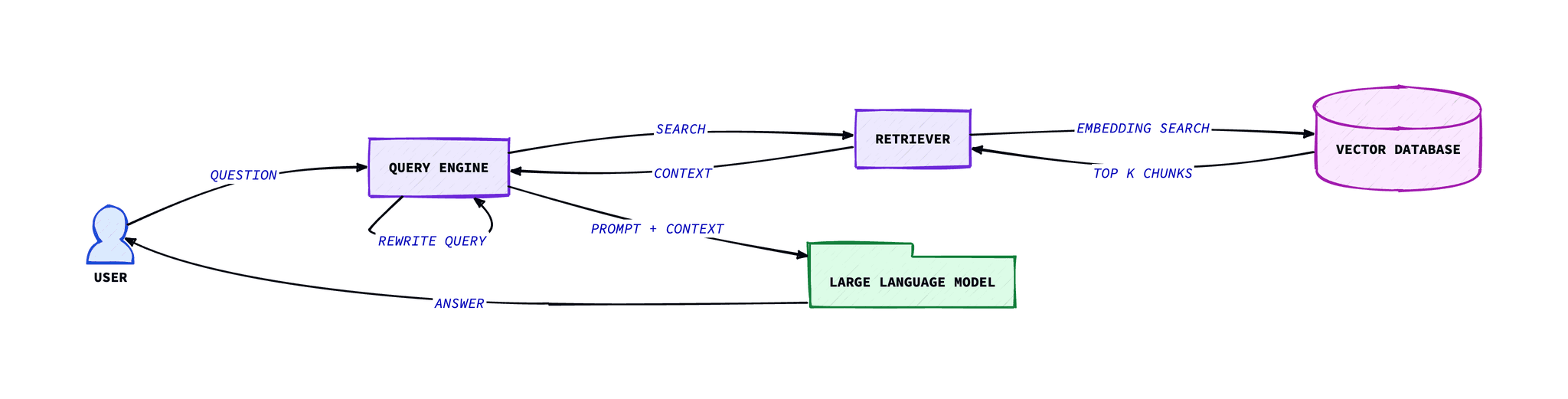
Modular RAG treats the retrieval pipeline as a composable workflow. It includes query rewriting, routing between different indexes (SQL vs. Vector vs. Graph), and iterative refinement.
Advanced Retrieval Patterns
Simple cosine similarity is rarely enough for enterprise queries.
1. Hybrid Search
Combines Dense Retrieval (Vectors/Semantic) with Sparse Retrieval (BM25/Keywords).
Why?Vectors are great for concepts ("healthy food") but bad for specific IDs or exact phrases ("SKU-12345"). Hybrid search gets the best of both worlds.
2. Re-ranking
A "Cross-Encoder" model (like Cohere Rerank) scores the top 50 retrieved chunks against the query with high precision, re-ordering them to ensure the context window contains only the most relevant data.
3. Query Transformation
Never trust the user's raw query. Use an LLM to rewrite it.
User:"Compare it to the other one."
Rewritten:"Compare the Q3 financial report to the Q2 financial report."
Semantic Chunking & Indexing
Garbage In, Garbage Out. If you split a sentence in half, semantic meaning is lost.
- Recursive Character Split: Good baseline. Splits by paragraphs, then newlines, then spaces.
- Document-Specific Split: Uses structure (HTML tags, Markdown headers) to keep sections together.
- Semantic Split: Calculates embedding similarity between sentences and only breaks chunks when the topic shifts.
Parent-Child Indexing:Retrieve small chunks for precision, but feed the "Parent" (larger context) to the LLM for coherence.
The Rise of GraphRAG
Vector databases flatten the world into lists. Knowledge Graphs preserve structure.
GraphRAG uses an LLM to extract entities and relationships from text during indexing. At query time, it can traverse these relationships.
Example:"How does the supply chain risk in China affect our US production?"
Vectors might find articles about "China" and "US". GraphRAG follows the path:China Factory --supplies--> Component X --used_in--> US Product Y.
Evaluating RAG Systems
You cannot improve what you cannot measure. The RAG Triad is the standard framework:
Context Relevance
Did we retrieve the right chunks? (Precision/Recall)
Groundedness
Is the answer fully supported by the chunks? (No hallucinations)
Answer Relevance
Does the answer actually address the user's question?
Security & RBAC in RAG
Enterprise RAG must respect permissions. If a user cannot see a document in SharePoint, they must not be able to retrieve its chunks in RAG.
Solution: Embed Access Control Lists (ACLs) into the vector metadata.{ "content": "...", "allowed_groups": ["hr", "management"] }. Filter retrieval by the user's group membership before the vector search.
Reference Architecture
# Enterprise RAG Stack 2026

1. Ingestion: Unstructured.io (PDF/PPT parsing)
2. Orchestration: LlamaIndex / LangChain
3. Indexing: Hybrid (Pinecone + ElasticSearch)
4. Knowledge Graph: Neo4j
5. Retrieval: Hybrid Search + Cohere Re-rank
6. Generation: vLLM (Llama 3 70B) or GPT-4o
7. Evaluation: Ragas / Arize Phoenix
Conclusion
RAG in 2026 is a sophisticated data engineering discipline. It requires moving beyond "magic" demos to building observable, secure knowledge pipelines with clear failure modes. By combining vectors, graphs, and hybrid search, enterprises can access the value of their proprietary data with Generative AI.